Free printable · Kindergarten to Grade 5
Free size of the problem chart: how big is the problem?
Change the steps, pictures or language. Free account, no card.
The PDF is free to download and print. No sign-up.
📬 Get a new free page each week
One free page each Monday. Unsubscribe anytime. How we use it
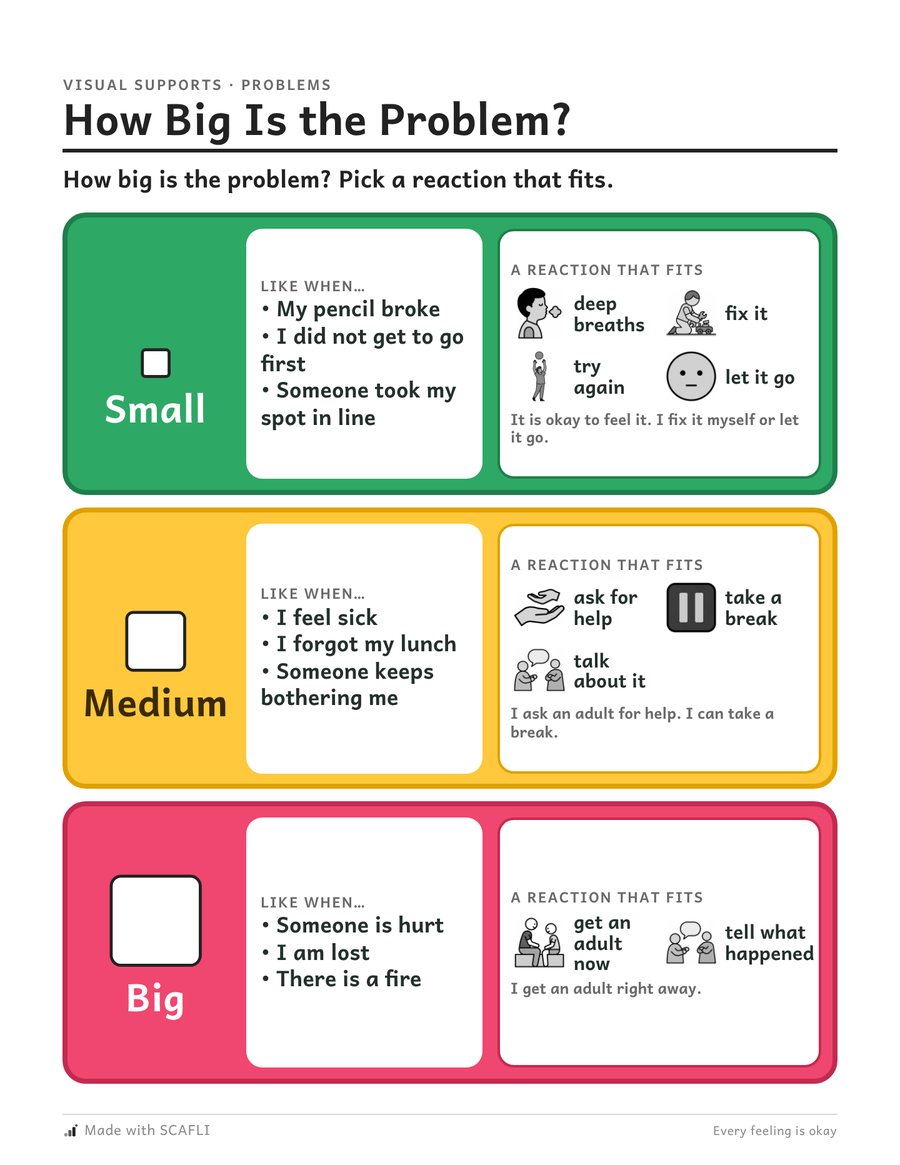
How Big Is the Problem? sorts problems into three sizes, each in its own color: small (my pencil broke, someone took my spot in line), medium (I feel sick, I forgot my lunch) and big (someone is hurt, I am lost, there is a fire). Beside each size are reactions that fit it, with a picture: take deep breaths and fix it, ask for help or take a break, get an adult now.
Save to PinterestMake your own
Ask for the problems your student really has, a version for older students, or a size of the problem game on screen, and SCAFLI makes it.
Try asking for:
Start with a free week. No card needed. Every free printable stays free to download, no account needed.
What else SCAFLI does
Short videos, no sound needed. Tap one to play it here.
SCAFLI for teachers, in one minute
The whole idea in one minute.
Your planning sheet, materials made
Bring in your plans; each class gets its page.
Paper worksheet? Snap it
Photo from your phone, then adapt it.
All the videos →👀 See a sample week
With a free account, SCAFLI makes pages like this for your own student: any grade, any topic, on paper and on screen.
Create your free accountWhat it is
A visual for matching a reaction to the size of a problem, for social-emotional lessons, counseling, speech and language groups and the calm corner.
How to use it
- Teach it when everyone is calm, with made-up problems first.
- Sort a few problems together: is this small, medium or big?
- In the moment, point to the chart and ask: how big is it? What reaction fits?
Three quick tips
- Say that every feeling is okay; the chart is about the reaction.
- Use the student's own small problems as examples.
- Praise a small reaction to a small problem when you see it.
Questions
- Can I use it on a screen?
- Yes. There is a version on screen where students tap the size of a problem.
- What age is it for?
- Kindergarten to fifth grade, and older students who need a visual for it.
- Is it the same as a feelings chart?
- No. A feelings chart names a feeling; this chart matches a reaction to how big the problem really is. They work well together.
A starting point for your own professional judgment. Use initials only on any page about a student.