Free printable · Grades 4 to 12
Free self-monitoring checklist
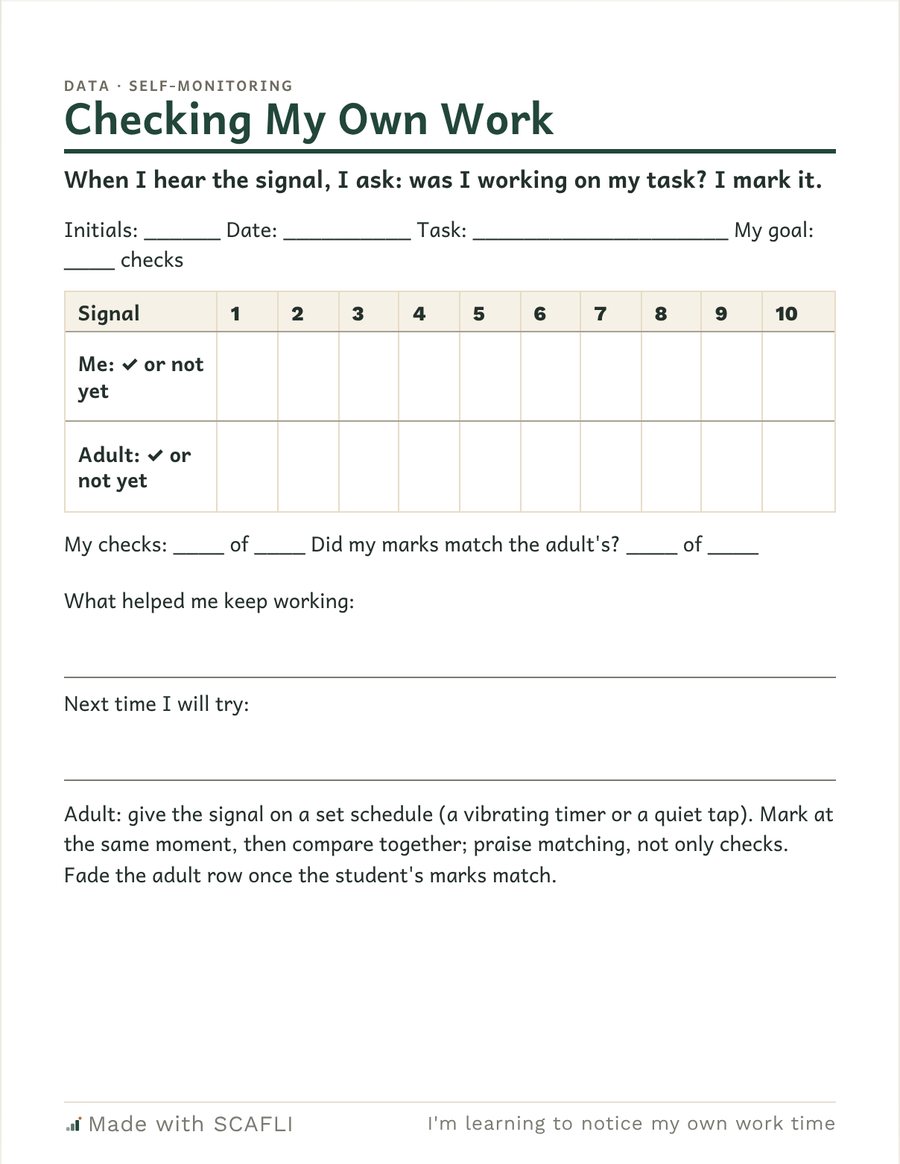
A self-monitoring chart for on-task behavior. At each signal, a quiet vibration or a tap, the student asks, was I working on my task, and marks it. An adult marks the same moments so they can compare and talk about it.
Download free PDFNo email needed. Print as many as you need.
Make your own in seconds
Ask for a self-monitoring chart for a different behavior or time period, and SCAFLI makes it.
Try asking for:
- “check in check out sheet”
SCAFLI is in early access. The free PDF above needs no sign-up.
What it is
A self-monitoring tool for on-task behavior, used in classrooms and behavior plans, for upper elementary through high school.
How to use it
- Agree on the signal and the task before starting.
- Mark at the same moments as the student.
- Compare marks afterward and praise matching, not only checks.
Three quick tips
- Start with short sessions.
- Fade the adult row as the student gets accurate.
- Use a vibrating timer so it's private.
Questions
- What is self-monitoring?
- A student noticing and recording their own behavior, a well-established support for staying on task.
- Who is it for?
- Students from upper elementary through high school, often as part of a behavior plan.
- Can I change the behavior?
- Yes. Ask SCAFLI for a self-monitoring chart for any behavior.
A starting point for your own professional judgment. Use initials only on any page about a student.