Built by an SLP · The early access list is open
The right support for every student,
ready in minutes.
Tell SCAFLI what your student needs. Get a finished page, talking board or schedule to print or use on any device.

Digital · tap to earn tokens
Join the list and we'll email you when your spot opens.
Founding Member rate for early sign-ups
- Type itSay what your student needs.
- Get itA finished page appears.
- Print or playOn paper or on an iPad.
Try a talking board ↓See more examples ↓
“Definitely something I would use!! Especially for the data sheets.”
Built by an SLP · Made for SLPs, special educators, teachers and families
- Research-informed
- Built by a school SLP
- Paper and any device
- No student names needed
New this weekTalking boards for places like the store, a restaurant and the park · My Library sorted by student (initials only)
A page for every goal.
Kindergarten to high school, SLP to algebra. Every page below came from one typed request.


High school · Math“3 versions of my Algebra 1 equations quiz, with answer keys”
Try a talking board
Tap. Build. Say it.
This is a real SCAFLI talking board. Tap a few words, then press Say it. Every board works on a phone, an iPad and on paper, with the words in the same places.
Word colors follow the Fitzgerald Key used on AAC devices.
Ready for the whole day
One support, everywhere they go.
For any age, from a kindergartener's first-then to a young adult's job steps.

At school
- A first-then board for a kindergartener
- A locker-and-class checklist for a middle schooler
- The class reading page, with more support

At home
- A morning routine on the fridge
- A feelings check-in on a teen's phone
- The same talking board as school

Out in the community
- A grocery trip board with the list
- Ordering at a restaurant
- Job steps for a young adult
Every student's boards in one place
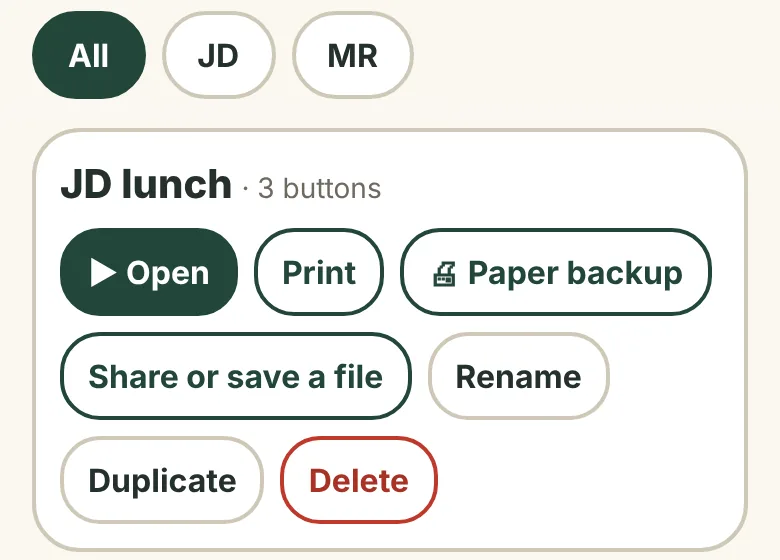
My Library sorts saved boards by student. Initials only, never a name.
Share it
Send a board home.
The family uses the same board as school, and a colleague can use it too. Same words, same places.




 Breakfast
 Get dressed
 Bus
BusThe same board on the phone and on the fridge. Send it home with one link.
- 1Make itA talking board, schedule or routine, made for one student.
- 2Send a linkCopy the link or show the QR code. Share it with a family or a colleague.
- 3They open itIt opens on their phone, no account needed, and they can keep it.
No student names. Nothing stored on a server.
Why it works
AAC is meant to go everywhere a student goes, and everyone who helps them can learn to use it.
ASHA Practice Portal: AACFamilies are key members of the team. Their input helps students use AAC in everyday life, not just at school.
ASHA Practice Portal: AACResearch supports using visual supports, and experts recommend using them the same way across settings.
AFIRM: Visual SupportsVisual supports work from toddlers through young adults, not just young children.
AFIRM: Visual SupportsPracticing during everyday routines helps skills carry over to real life.
ASHA Practice Portal: AACA paper copy is a good backup when a device needs charging, is being repaired, or can't go along (like the pool).
AbleNet: light-tech backups for AAC
Why SCAFLI
You know your students best. Let SCAFLI handle the rest.
53hrs
The average teacher's work week, compared with 44 for similar jobs.
RAND, 2024
76%
of school SLPs name paperwork as the #1 challenge.
ASHA, 2024
Up to ½
of a special educator's time can go to paperwork.
Vannest & Hagan-Burke, 2009
71%
of K–5 reading teachers spend 1 to 5+ hours a week searching for materials.
WeAreTeachers, 2024
SCAFLI handles the making, so you can handle the teaching.
Sources: RAND State of the American Teacher (2024); WeAreTeachers Science of Reading survey (2024); Vannest & Hagan-Burke (2009) and Suter & Giangreco (2009); ASHA 2024 Schools Survey, SLP workforce report.
One lesson, every student
Keep the goal. Change the support.
Bring the class lesson. SCAFLI makes the plan for the adults plus a page for each student's goal, all on the same topic.


- Push-in
- Speech room
- Small group
Pushing in today? Ask what the class is learning, and walk in with the right support for every student on your caseload.
Why educators use SCAFLI
Keep the Goal. Change the Support.
Students get the cues, visuals, or practice they need to work toward the same goal.
Skills Beyond One Room.
Familiar cues help students use a skill in therapy, in class, and at home.
Less Searching. More Supporting.
Make the material your student needs without hunting for something close enough.
Know Why It Helps.
Tap “Why this?” to see the reasoning and research behind a student's support.
Same goal. Different support.
Drag to see the same questions on a plain page and with SCAFLI's supports. Pick a level to see what changes, and who it's for.
SCAFLI · MORE SUPPORT
Bees
Bees live in hives.
Worker bees collect nectar from flowers and make honey.
The queen bee lays eggs.
Bees help flowers grow by moving pollen.


1. Where do bees live?
2. What do worker bees collect?
3. How do bees help flowers?
Bees
Bees live in hives. Worker bees collect nectar from flowers and make honey. The queen bee lays eggs. Bees help flowers grow by moving pollen.
Answer the questions.
1. Where do bees live?
2. What do worker bees collect?
3. How do bees help flowers?
For a student who loses their place: one sentence per line, pictures, and a box for each answer.
What SCAFLI can do for you
One place for the materials you make every week.
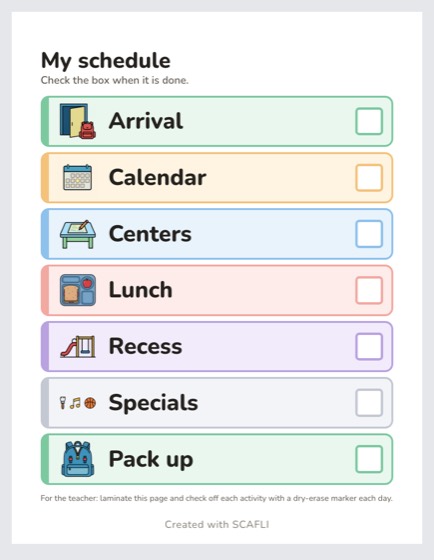
Visual schedules
A picture schedule with a box to check off each step.
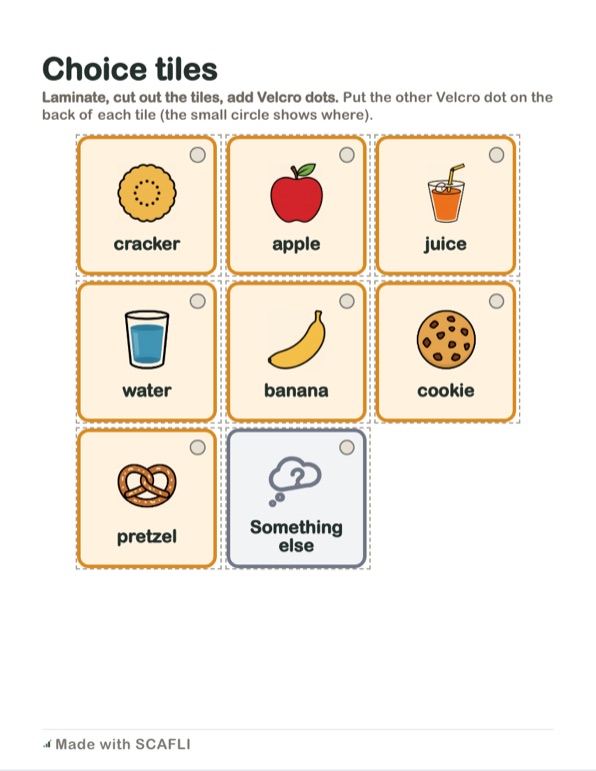
Choice boards
Pictures to point to: I want, more, help, done.
Picture stories
A short first-person story with one picture a page.
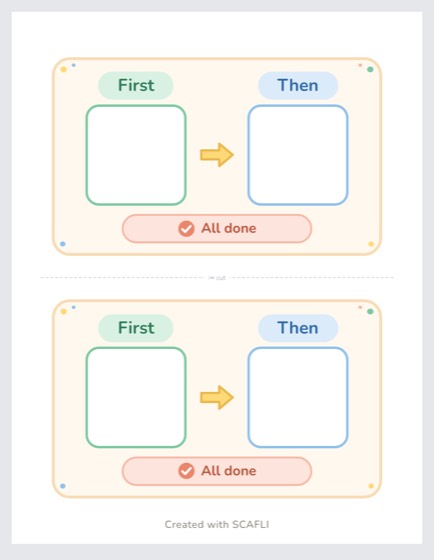
First-Then boards
Show what comes first and what comes next.
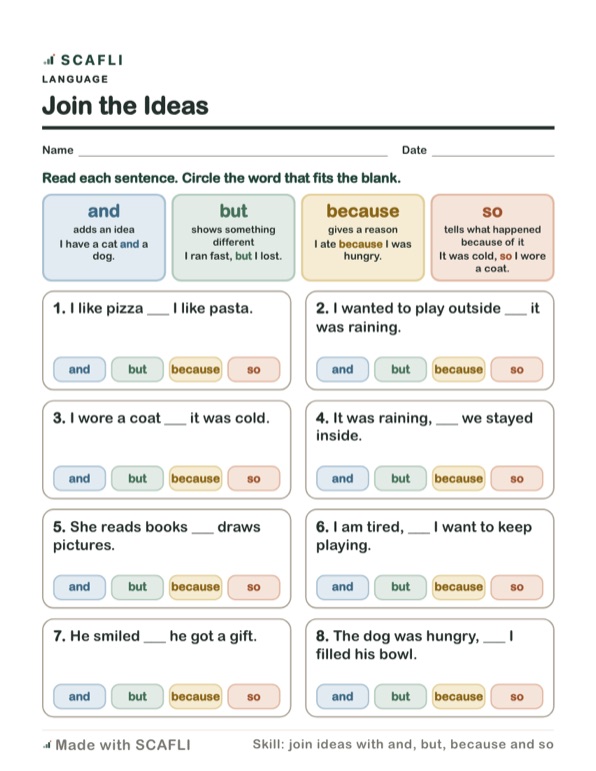
Same page, easier reading
Keep the questions. Change the support.
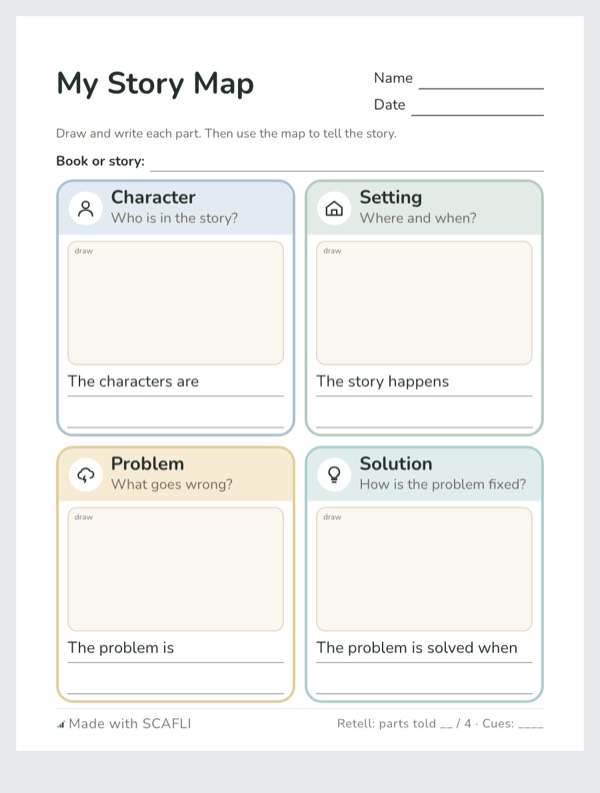
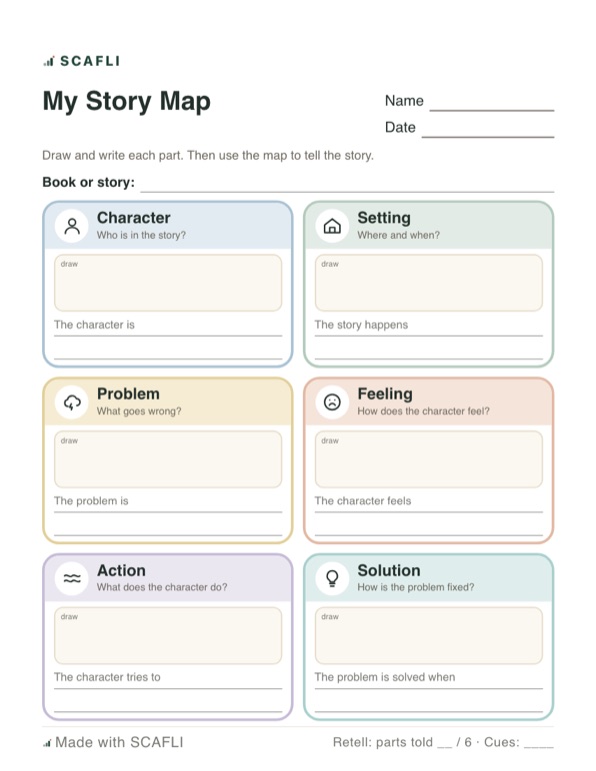
Story maps
Character, setting, problem, solution on one page.
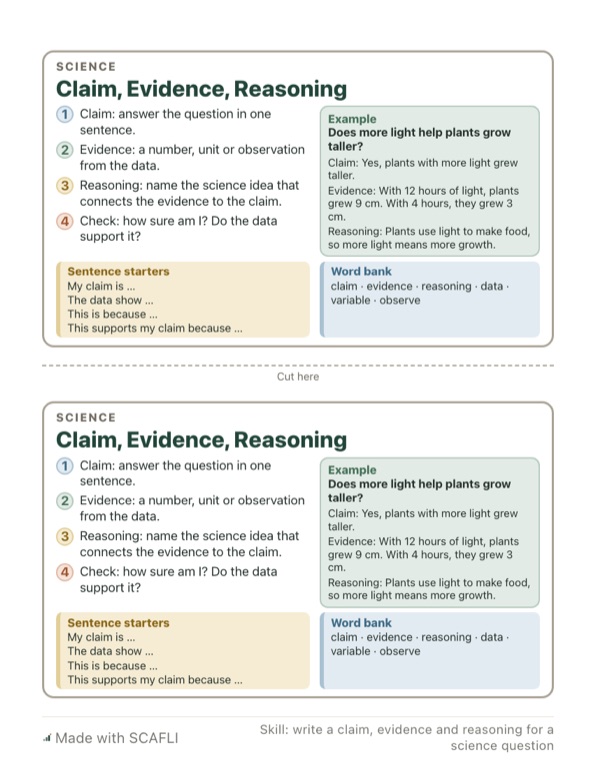
Reference cards
Steps, one worked example, starters and a word bank.
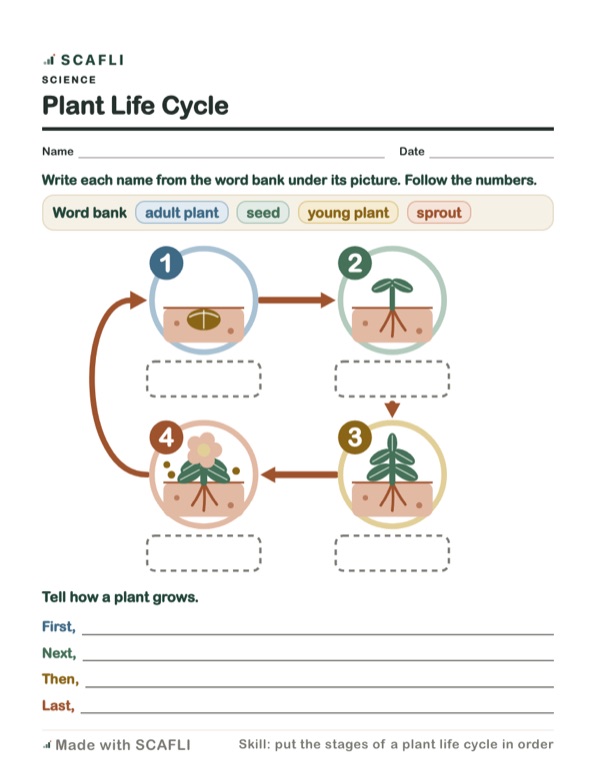
Guided notes
Your lesson with only the key words left blank.
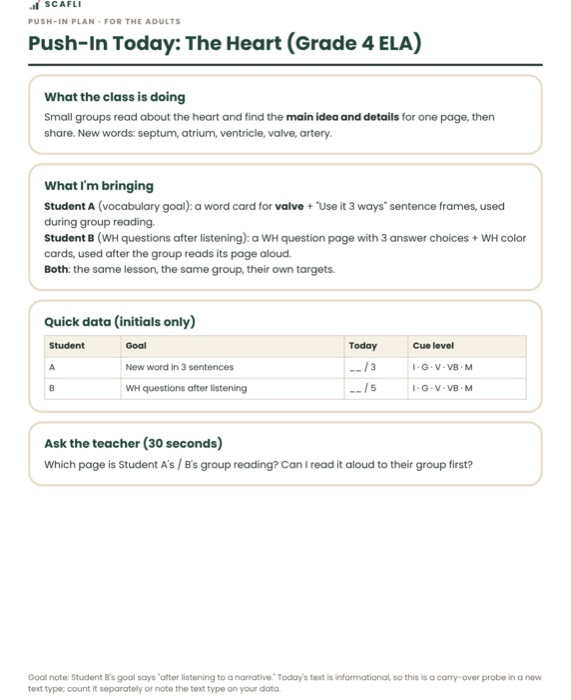
Lesson companion
Supports for push-in or the speech room, from the class lesson.
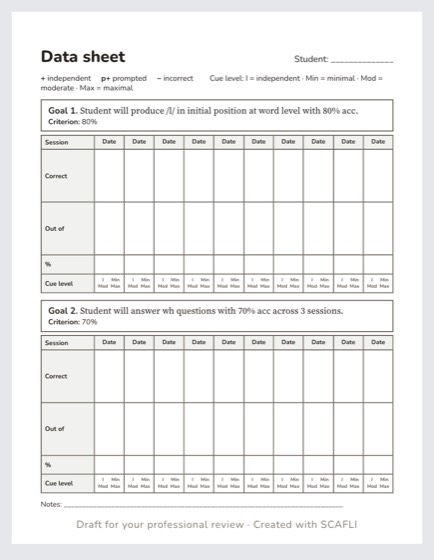
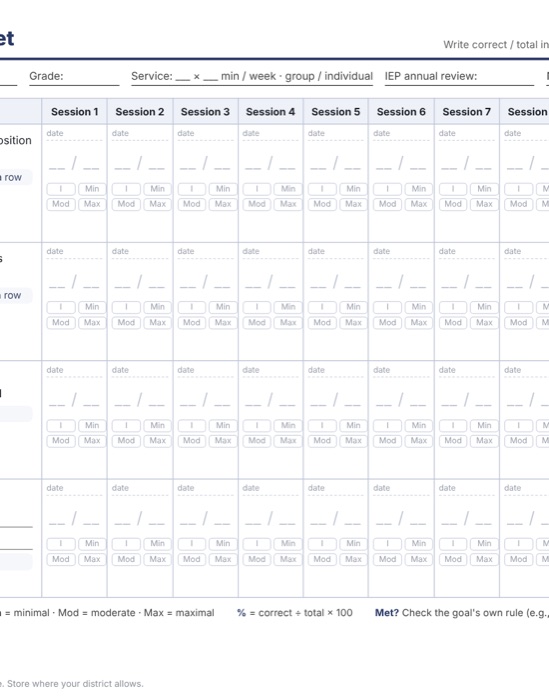
IEP data sheets
Tap to record trials. Stays on your device.
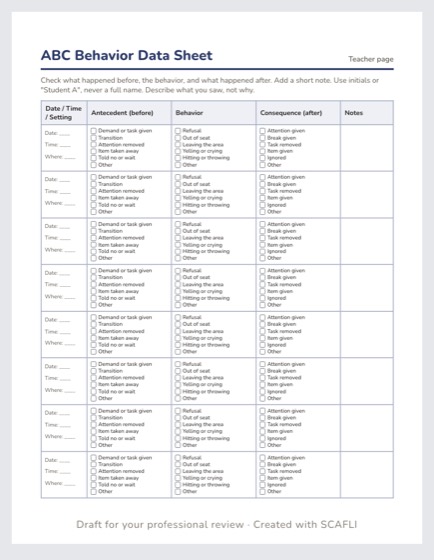
IEP trial sets
Four trial pages for a goal, with a scoring page.
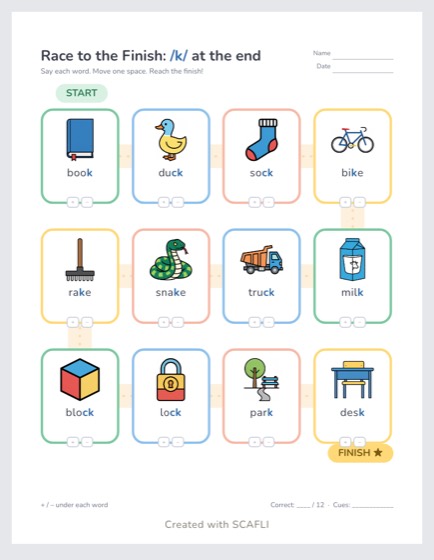
Articulation games
Digital or print practice for a speech sound.
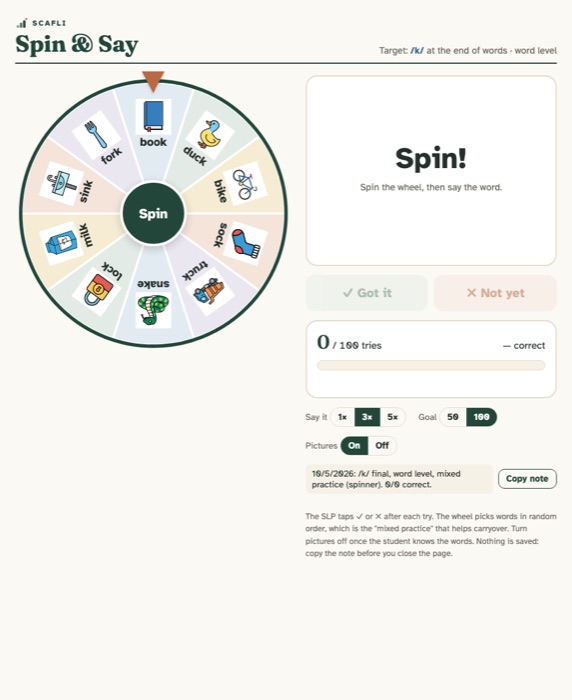
Game companions
Turn a game you own into language practice.
Language sample forms
Transcript, quick tally and session notes.
Helper guides
A script and models, so helping feels easy.
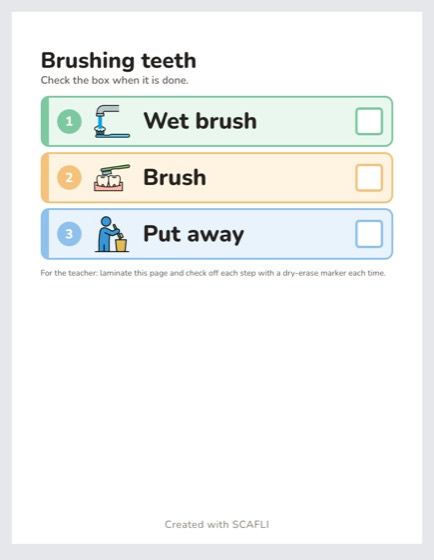
Posters and routines
Hand washing, waiting, calm-down steps with pictures.
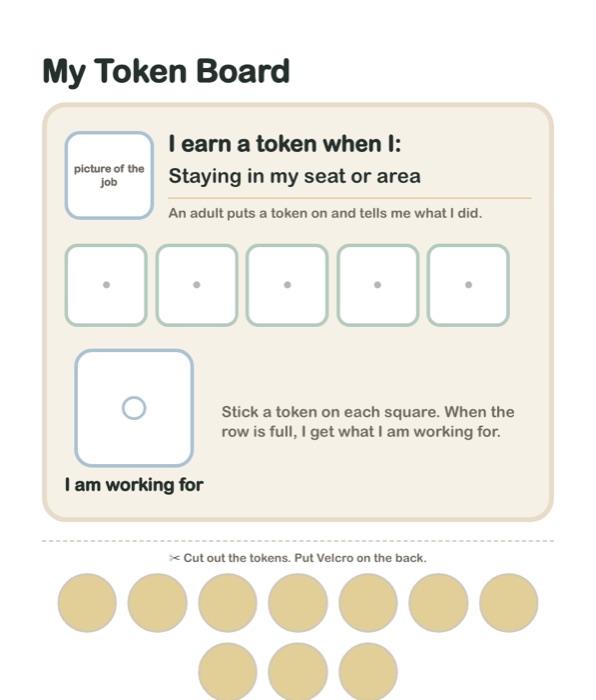
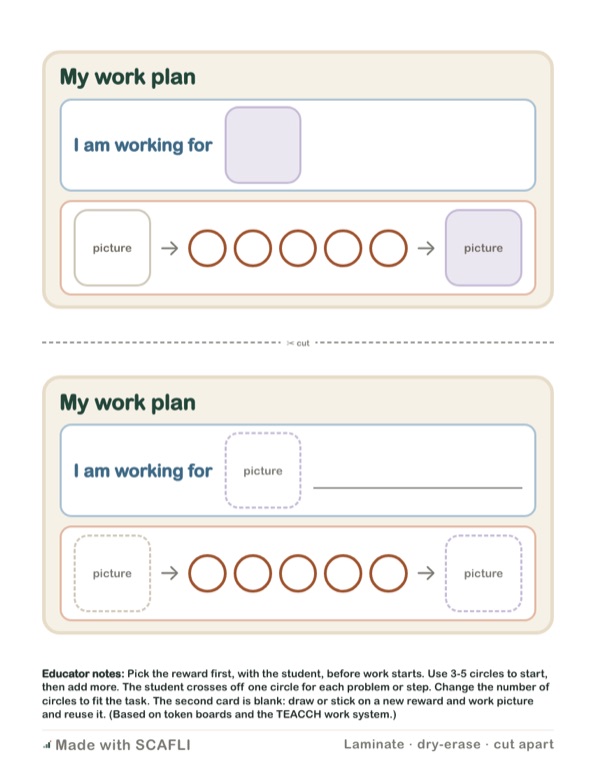
Reward and token charts
Token boards and fill-up charts, printed or to play on screen.
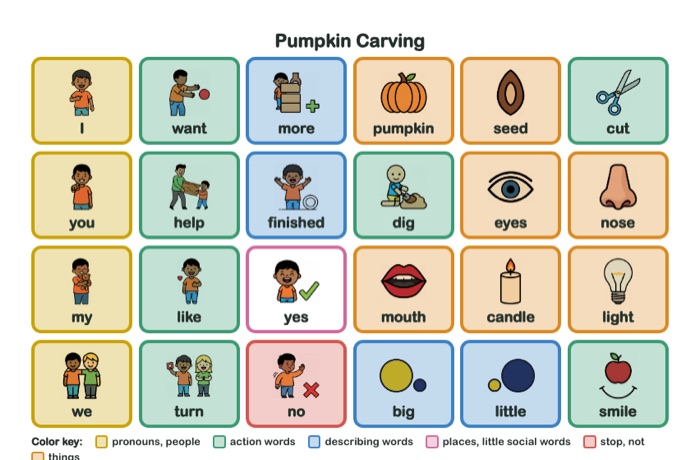
Talking core boards
A core word board that speaks on a tablet.
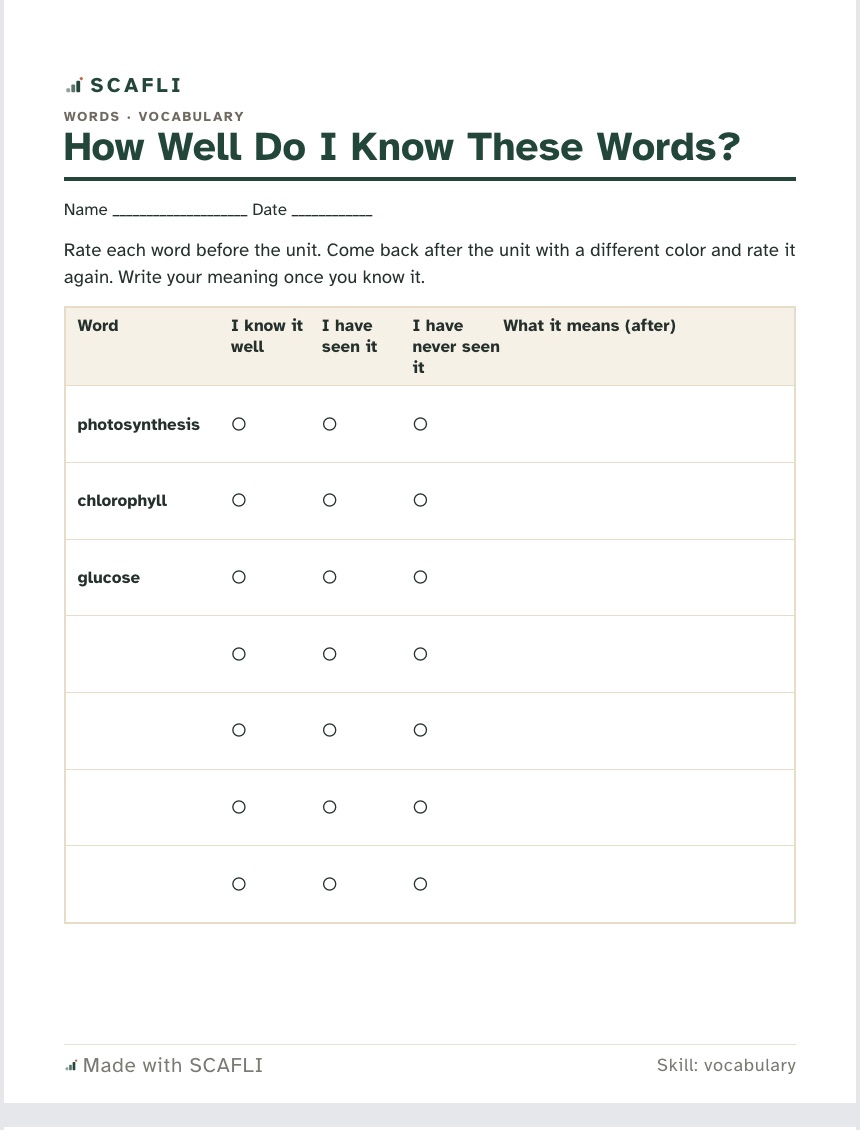
Vocabulary organizers
Self-rating charts and word maps for new words.
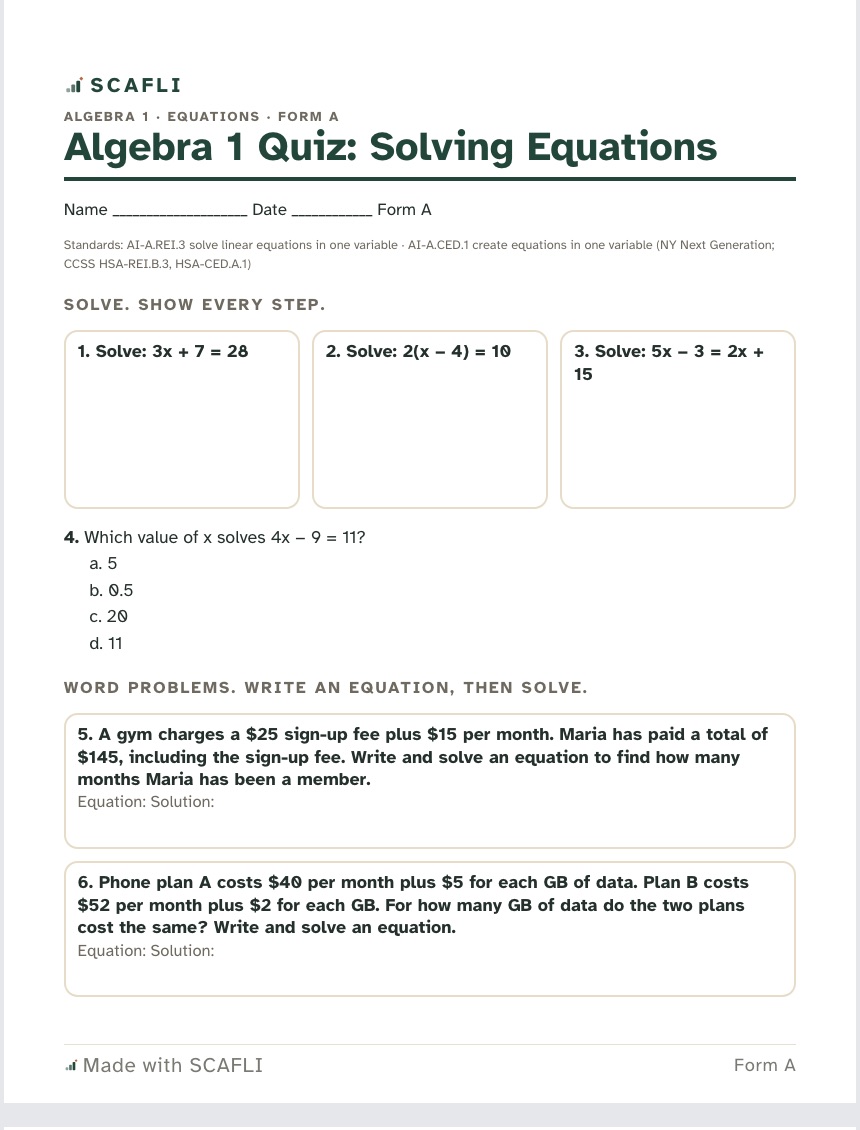
Test versions A/B/C
Parallel forms with the same skills and a key for each.
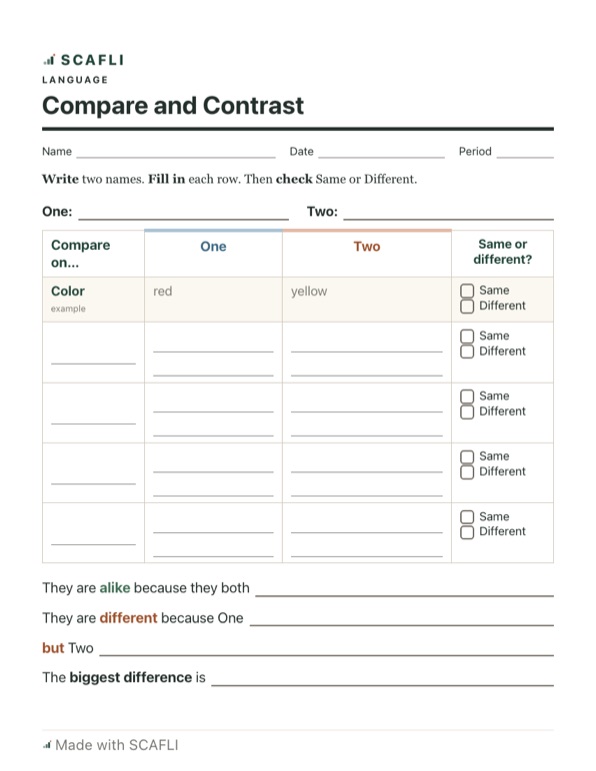
Fill in my chart
Photograph your handout; SCAFLI fills in examples and pages.
Sized for how you use it
Full page, desk strip, half page, cut-apart cards. Print or digital.
Print for my group
A, B, C, D copies with different items, and one answer key.
Stickers for finishing
Kids pick a sticker when a game ends; they collect on their own page.
Print or digital · any grade, K–12 · built from your lesson, your goals, your students.
How it works
Describe it
Say what you're noticing the way you'd tell a colleague. No perfect prompt needed.
SCAFLI builds the support
It picks a research-informed strategy, writes at the right level and keeps the learning goal the same.
Print it, play it, tweak it
Print the page or play it on screen. Click any sentence to edit, or ask SCAFLI to change it in plain words.

Why I built SCAFLI
Every student has different needs: more support, references, communication boards, modifications, or a routine they can count on.
Teachers, SLPs, special educators and families know how to help and support them, but don't always have the time and resources to make it all happen.
That's why I built SCAFLI. Research-informed supports, ready in minutes and easy to share, so every student has the materials, language and access they need to learn, communicate and build life skills. Wherever their day takes them, the right support can go with them.
– Maddy
Maddy Schwartz, M.S., CCC-SLP, TSSLD
School SLP & founder
Quick questions
Is it free during early access?
Yes. SCAFLI is free while we're in early access.
Is there a Founding Member rate?
Join during early access and become a Founding Member. Free while we're in early access. Founding Members get a special rate when paid plans launch.
Do I need to type student names?
Never. Describe what a student needs; leave names out.
Does it work on an iPad?
Yes. Print a page or play it on an iPad.
Who is it for?
The whole team around a student: teachers, SLPs, special educators, paras and families.
Can families use it?
Yes. An educator or SLP can send a board home with a link or QR code. It opens on a family's phone with no account, and they can print it or keep it.
Does it work with my student's AAC device?
It goes alongside it, never in place of it. Use a SCAFLI board as a paper copy for the pool or the playground, while the device charges, or for words the device doesn't have yet.
Can I use it right away?
You'll get an email when your spot opens.
SCAFLI never replaces your judgment. You know your students, and every page is easy to change before it goes out.
The early access list is open.
Join the list and we'll email you when your spot opens. Free during early access, and Founding Members get a special rate when paid plans launch. Know a teacher or therapist who'd love this? Bring them along.
Built by an SLP · Made for SLPs, special educators, teachers and families